Not seeing items you’ve added? Sign in
Features, Innovations, & Technologies
Child Restraint Anchorage System

Updated October 16, 2026
The child restraint anchorage system refers to integrated anchor points within a vehicle, along with corresponding components of a child car seat, that can be used to secure the seat within the vehicle. Formerly known as LATCH (Lower Anchors and Tethers for Children) in the United States, this system became standard for U.S. and Canadian car seats and vehicles in 2002. It’s also called LUAS (Lower Universal Anchorage System) in Canada and ISOFIX internationally. (Note, however, that the tether is not considered part of the LUAS system.)
The child restraint anchorage system includes two different sets of anchor points and child restraint components with unique functions: lower anchors / lower anchor attachments and tether anchors / tethers.
Lower anchors and lower anchor attachments are designed to secure a child restraint (aka a child car seat) in a vehicle without the vehicle seat belt. When installing your child’s car seat, you should choose just ONE method: lower anchor attachments or the vehicle seat belt. You may only install a car seat using both methods simultaneously if both your car seat and your vehicle allow it. Currently, Britax does not allow simultaneous seat belt and lower anchor attachment usage on any models.*
Tethers and tether anchors, on the other hand, help provide stability and reduce forward movement in the event of an impact. The tether is generally used for forward-facing car seats — although some all-in-ones and convertibles, like the Britax Galaxy360™, permit tether usage in rear-facing mode. Unlike the lower anchor attachments, the tether may be used when the child restraint is installed with the vehicle seat belt. In fact, Britax strongly recommends tether usage for our forward-facing car harnessed seats in the U.S., and it’s required for forward-facing harnessed seats in Canada.
To Sum Up: Lower anchors and their corresponding attachments provide an alternative installation method to the vehicle seat belt, while tethers and tether anchors are an additional feature for forward-facing harnessed car seats that are designed to be used with either lower anchor or seat belt installation.
Lower Anchor & Lower Anchor Attachment Locations
Lower anchors are metal bars located in the vehicle seat bight (where the bottom cushion and back cushion meet). Sometimes you can see the lower anchors just by looking at the seat, but they may be hidden in the bight depending on your vehicle. If you’re unsure about lower anchor locations in your car, check your vehicle owner’s manual and/or look for the lower anchor symbol (shown below) on a tag or plastic button on your rear vehicle seats.

Lower anchor attachments are generally located on the lower part of a car seat (or, for infant seats, integrated into the base). They may be visible on the back of the seat or located within a storage compartment. You can identify them by looking for the symbol pictured above.
Some connectors are attached to flexible webbing, while others are fixed to a metal bar that slides in and out of the car seat (this type is often called rigid LATCH or rigid lower anchor attachments). They may have a metal J hook on the end or a quick-push attachment mechanism. Be sure to read your car seat user guide to identify the lower anchor attachments and understand how they work on your particular seat.
Lower Anchor Weight Limits
When installing a child restraint using the lower anchor attachments, you’ll need to be mindful of the weight limits. These can be found in your car seat user guide and on the car seat labels. Convertible and all-in-one seats generally have different lower anchor attachment weight limits for rear-facing and forward-facing modes, so make sure you identify the correct limit for your current mode of use. If your child reaches the maximum, you’ll need to switch to the seat belt installation method instead.
Lower Anchors & Booster Seats
Some booster seats also include lower anchor attachments. However, they serve a different function than they do on harnessed car seats. On boosters, lower anchor attachments can help hold the seat in place when unoccupied, preventing it from becoming a projectile in case of an impact. Therefore, there’s no child weight limit for lower anchor attachments on booster seats or all-in-ones when used in booster mode.
Tethers & Tether Anchors
Tether anchor location varies depending on vehicle type. Tether anchors may be on the shelf behind the rear seat, on the back of the vehicle seat, or on the vehicle roof. Much like the lower anchors, you can identify tether anchors by checking your vehicle user manual and/or looking for the tether anchor symbol (shown below).
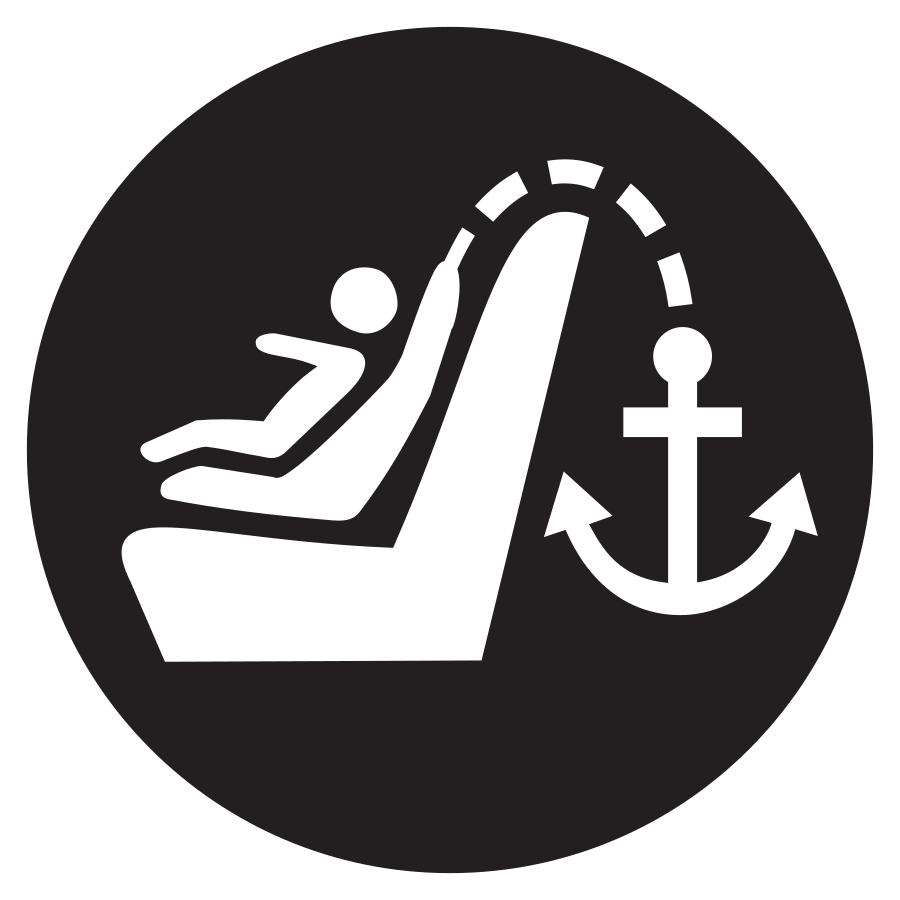
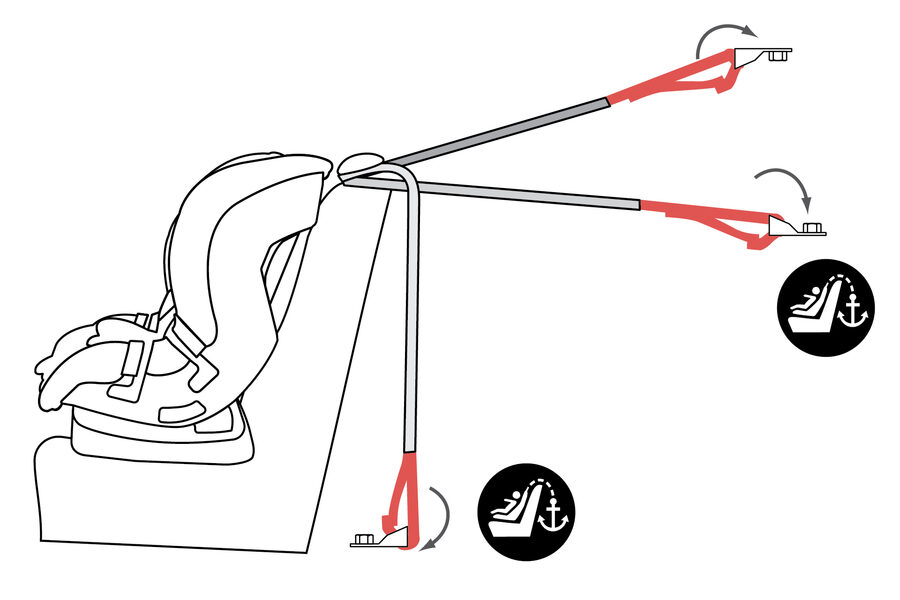
The tether itself will be located on the upper back part of the car seat, identifiable by the symbol shown above. Again, be sure to read your car seat user guide and your vehicle owner’s manual to understand how your tether works on your particular car seat.
Remember: The car seat tether is designed to help provide stability & reduce movement, but it is NOT a car seat installation method. Always install your car seat using either the seat belt or the lower anchor connectors. You may use the tether for forward-facing installations (and rear-facing for select models, as permitted by the car seat user guide) with either installation method.
Common Questions
Can I install Britax seats using both the lower anchor attachments and the vehicle seat belt at the same time?
No. Britax car seats should be installed using only one installation method — either the vehicle’s seat belt or the lower anchor connectors.
Which installation method is safer to use: lower anchor attachments or the vehicle seat belt?
Both the lower anchor attachments and the vehicle seat belt are safe installation methods when used correctly and independently of one another. The best method is the one that provides a secure and proper fit in your vehicle. Always refer to your vehicle owner’s manual and the car seat manual to determine the best installation method for your situation.
Can I install a forward-facing harnessed car seat in a vehicle seating position that does not have a tether anchor?
This will depend on your location and your car seat. In Canada, use of the tether is required for forward-facing harnessed car seats. In the United States, some car seat manufacturers strongly recommend tether usage while others require it. Check your user guide to confirm whether or not your car seat can be used in a seating position without a tether anchor.
Is the top tether required for forward-facing car seat installations on Britax convertible, all-in-one, and harness-2-booster car seats?
Britax strongly recommends (in Canada it’s required) that the top tether be used when installing the child seat forward-facing. Using the tether will improve the stability of the car seat and reduce the risk of injury.
Can I use the top tether in rear-facing mode on Britax convertible and all-in-one seats?
The only Britax car seat that permits tether usage in rear-facing mode is the Galaxy360™.* For all other convertible and all-in-one seats, the top tether is not designed to be used with rear-facing installations.
How should I store the top tether on my Britax car seat when it's not in use?
When the top tether is not in use, store the excess webbing in the attached elastic strap or the tether storage compartment located on the back of some of the Britax car seats. This helps ensure the tether is safely out of the way and ready for use when needed.
*As of October 2, 2026
Was this helpful?